
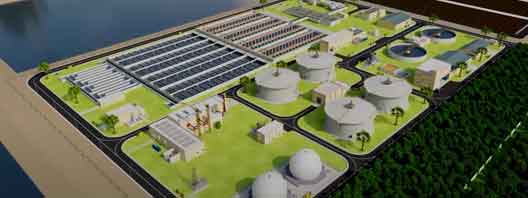
The first water treatment plant in Dhaka city was established by Nawab Khwaza Abdul Ghani in Chandnighat beside the river Buriganga named Dhaka waterworks’ in the year 1874, which was also the 1st water treatment plant in South Asia. From then the piped water supply was started in Dhaka city.
Dhaka Water Supply and Sewerage Authority (Dhaka WASA)
Dhaka WASA was established in the year 1963 as an independent organisation, under the WASA Ordinance No. XIX of 1963.
Currently, Dhaka WASA is being governed under the Water Supply and Sewerage Authority Act, 1996 (http://bdlaws.minlaw.gov.bd/act-804.html). The drainage system of Dhaka city was handed over to Dhaka WASA from the Department of Public Health & Engineering (the “DPHE”) in 1989. Beside this, the water, drainage and sewerage services of Narayangonj City were also handed over to Dhaka WASA in 1990. However, the water, drainage and sewerage services of Narayangonj City were transferred to Narayangonj City Corporation from Dhaka WASA under a signed MoU in FY 2019-2020. On the contrary, the drainage system has also been transferred to Dhaka North City Corporation and Dhaka South City Corporation from Dhaka WASA under another signed MoU in FY 2020-2021.
Provide city dwellers with clean water and safely managed sewerage disposal and necessary all other things. (For details, please see: http://bdlaws.minlaw.gov.bd/act-804/section-33633.html).
To ensure improved potable water supply and safely managed sewerage facilities to the city dwellers. (For details, please see: http://bdlaws.minlaw.gov.bd/act-804/section-33633.html)
To be established as the best water utility provider in the public sector of Asia through environment friendly, people-oriented and sustainable water management.
· Best customer service provider organization
· Increasing the usage of surface water by reducing the dependency on ground water
· Formulation of corporate systems in management and governance
· Ensuring high standards of transparency and accountability in all services and activities
· Increasing the efficiency and reducing the operational costs in all activities of Dhaka WASA.
· Development of water supply management and improvement of water supply network system
· Organizational capacity development
· Increase the usage of surface water in sustainable water management
· Development of digitalized water supply and sewerage system, financial system and billing services
· Establishing transparency in official activities and ensuring accountability
· Improving performance and service quality
· Development of finance and assets management.
· Integrity
· Honesty
· Transparency.
· Promise to customers for best water utility services
· Commitment to sustainability
· Automation and Digitalization
· Teamwork
· Professionalism
· Good Governance
Dhaka WASA is an autonomous body with the mandate of water supply and sewerage disposal for the city dwellers. It is a service oriented commercial organization under the supervision of Local Government Division (LGD), Ministry of Local Government Rural Development and Cooperatives (LGRD & Cooperatives).
The address of its head office is
WASA Bhaban, 98 Kazi Nazrul Islam Avenue, Karwan Bazaar, Dhaka-1215.
Yes, Dhaka WASA is governed by its Board.
The Dhaka WASA Board is the ultimate authority for the overall management of the organization within the framework of the prevailing law. The Board comprises 13 members nominated by the Government. Under the guidance of Dhaka WASA Board, Dhaka WASA’s strategic functions are run by a management team headed by the Managing Director and four executive directors, those are Deputy Managing Director (Operation & Maintenance), Deputy Managing Director (Research, Planning & Development), Deputy Managing Director (Finance), and Deputy Managing Director (Admin).
It covers more than 360 sq km service area with more than 20 million people of the mega city Dhaka.
i) Professor Dr. Engr. Sujit Kumar Bala, worked at Institute of Water and Flood Management (IWFM) at BUET, is the Chairman of Dhaka WASA Board
The other members of the Board are:
ii) Md. Khairul Islam, Additional Secretary, Local Government Division, Ministry of LGRD and Cooperatives
iii) Dr. Ziaul Abedin, Joint Secretary, Macro-Economic Policy Analysis and Forecasting, Ministry of Finance
iv)Mr. Imran Ahmed, Former Vice President, Dhaka Chamber of Commerce and Industry (DCCI)
v) Mr. Sabbir Ahmed, FCA, Vice President, The Institute of Chartered Accountants of Bangladesh (ICAB)
vi) Position of the representative of Institute of Engineers Bangladesh is vacant currently.
vii) H. A. M. Zahirul Islam Khan, Advocate, Bangladesh Supreme Court; Member, Bangladesh Bar Council
viii) Md. Dip Azad, Secretary General, Bangladesh Federal Union of Journalists (BFUJ)
ix) Dr. Mostafa Jalal Mohiuddin, President, Bangladesh Medical Association (BMA)
x) Engr. A K M A Hamid, President, Executive Committee, Institution of Diploma Engineers, Bangladesh
xi) Ms. Shikha Chakrabarty, Councilor, Ward No. 6, 7, 8 (seat-14 & 16), Dhaka North City Corporation
xii) Kha. Ma. Mamun Rashid Shuvro, Councilor, Ward No. 12, Dhaka South City Corporation
xiii) Managing Director & Chief Executive, Dhaka WASA .
Engr. Md. Abdus Salam Bapary is the Managing Director of Dhaka WASA. He is also a member of the 13-member Dhaka WASA Board.
Dhaka Water Supply and Sewerage Authority
Head Office
WASA Bhaban
98 Kazi Nazrul Islam Avenue, Karwan Bazaar, Dhaka 1215
Call Centre: 16162, Phone: 5501 2416-22
E-mail: info@dwasa.org.bd
Website: www.dwasa.org.bd, www.dwasa.gov.bd
Fb: www.facebook.com/dhakawasa1996
Twitter: www.twitter.com/dhakawasa
Instagram: www.instagram.com/dhaka.wasa
Dhaka WASA Zonal Offices
MODS Zone 1
Executive Engineer
Jatrabari (Near Ideal School and College), Dhaka
(+88 02) 935 8397, (+88) 01819-229419,
dwasa.modsz1@gmail.com
MODS Zone 2
Executive Engineer
Chandnighat, Chawkbazar, Dhaka
(+88 02) 901 6016, (+88) 01819-229415,
modszone2@gmail.com
MODS Zone 3
Executive Engineer
Lalmatia (Steel Water Tank Compound), Mohammadpur, Dhaka 1207
(+88 02) 810 0010, (+88) 01819-229418,
eemodszone3@gmail.com
MODS Zone 4
Executive Engineer,
Darussalam (Near Bangla College), Mirpur 1, Dhaka
(+88 02) 900 519, (+88) 01819-229417,
eemodszone4@gmail.com
MODS Zone 5
Executive Engineer
Mohakhali, Dhaka 1212
(+88 02) 989 9338, (+88) 01819-229416,
modszone05dwasa@gmail.com
MODS Zone-6
Executive Engineer
Fakirapul (Fakirapul Water Tank),
Motijheel, Dhaka
(+88 02) 719 1569, (+88) 01819-229420,
eemodsz6@gmail.com
MODS Zone 7
Executive Engineer
Jatrabari (Near Ideal School and College), Dhaka
(+88 02) 7547929, (+88) 01763-051234
eemodsz7@gmail.com
MODS Zone 8
Executive Engineer
Gulshan (Opposite of American Embassy), Dhaka
(+88 02) 883 4239, (+88) 01819-556318
modszone8dwasa@gmail.com
MODS Zone 9
Executive Engineer
House 7, Road 3, Sector 3, Uttara (Near Friends Club), Dhaka
(+88 02) 791 1910, (+88) 01819-208902
eemodszone9@gmail.com
MODS Zone 10
Executive Engineer
Mirpur Circle 10 (Near Water Tank), Dhaka
(+88 02) 900 5948, (+88) 01817-144495
dwasamodsz10@gmail.com
Dhaka WASA is a service-oriented autonomous commercial organization in the public sector under the supervision of Local Government Division (LGD), Ministry of Local Government, Rural Development and Cooperatives (LGRD & Cooperatives).
Dhaka WASA is entrusted with the responsivities of:
i) Providing potable water supply and
ii) Safely managed sewerage services
to more than 20 million people living in a 360 sq km service area.
In 2009, under the leadership of Hon’ble Prime Minister Sheikh Hasina, the whole water supply policy was turned into an environment friendly, sustainable and pro-people water management system. In achieving this change management policy, DWASA set its vision & mission and declared an action plan called “Dhaka WASA Turn-around Program” which was started in 2010.
The achievements, so far, are briefly as follows:
Dhaka WASA is currently capable of producing 2700 million liters of water per day (MLD) against the daily demand of 2600 MLD for more than 20 million people in 360 sq. km. service area. In 2009, for 12.50 million people the water demand was almost 2120 MLD and water production was 1880 MLD.
The revenue income (Serviced Delivery Earnings) of Dhaka WASA has been increased from 300 crore (3 billion) BDT in the Financial Year 2007 – 2008 to 1984.53 crore (more than 19 billion) BDT in the year 2021-2022.
Before 2009 the operating ratio was 0.90 which is reduced to 0.62 in 2023.
Implementation of mega projects both in water supply and sewerage sector.
In 2010, system loss (Non-Revenue Water-NRW) was around 40%. The loss has been reduced to 20% in 2023. But, introducing modern technology in water supply management, called District Metered Area (DMA), the loss (NRW) has been reduced from 40% to 5% in some areas. DMA will be introduced in the whole area to reduce NRW.
Bringing Low Income Community (LIC) under safe & legal water supply network.
Introduction of 100% real time online billing system.
a) Application procedure/s:
b) Cost:
c) Days will be needed for a connection:
a) Question: How to get a sewerage connection?
Answer:
b) Question: Do the citizens pay for sewerage management?
Answer:
c) Question: If yes, how do the citizens pay?
Answer:
d) Question: And how is the cost (for a family/unit/establishment)?
Answer:
a) Question: Which authority is responsible for installation of tube wells and deep tube wells in the city?
Answer:
b) Question: How to get permission for installation of tube wells and deep tube wells?
Answer:
c) Question: How will it cost?
Answer:
d) Question: How many days will be required to get these services?
Answer:
a) Question: Is Dhaka WASA capable of fulfilling the need of the city-dwellers in water supply?
Answer: The present demand for water in the city is 2550 to 2600 million liters per day (MLD) but, DWASA has the capacity of water production of 2650-2700 MLD from the existing available infrastructures and installations.
a)Question: Is Dhaka WASA capable of fulfilling the need of the city-dwellers in safe sewerage management?
Answer:
DWASA created a hotline 16162 in 2012. Various types of complaints are received by the site engineers from their respective areas through this link. The consumers also put complaints in the complaint centers in the zones either physically or through the telephone. In case of the complaint of contaminated water, the engineers visit the houses of the affected areas. They collect the samples from the houses. After testing the samples in DWASA’s laboratory the probable location can be identified by the team based on the concentration levels of contaminations. The engineers’ team dig the road or the house connections and repair or replace the damaged pipes. After that, the water samples are collected from the nearby houses and tested. Before the collection of the samples, the pipelines are disinfected by the chlorination process. There are complaints about reddish water and/pr water with a bad smell. It happens due to the presence of Iron in the supplied water from the Deep Tube Wells. In such cases the engineer’s team opens the valves of washout lines and wash out the red-type water till it comes to watercolor. A lot of complaints are mitigated instantly based on the nature of the complaints. The sewerage complaints were also mitigated by the zonal engineers.
Dhaka city was divided into 10 zones for its maintenance, operation, and distribution services. In short these are known as MODS zones. These MODS zones are responsible for providing water supply and maintenance in its area of jurisdictions as well as the sewerage facilities. There are two field maintenance divisions (FM) that are working in the maintenance of all pumps in the deep tubewells. Considering the present traffic congestion in the city and to improve and reduce the travel time for maintenance of pumps, the activities of these divisions were decentralized to 3 more sub offices. Duties of these sub-offices are to complete the maintenance works, especially repair or complete the breakdown works within 12 – 15 hours to make the pump operational. These offices are kept open for 24 hours for water supply as well as for the maintenance works.
The source of water that is supplied in the city is groundwater and surface water. Around 67% of water comes from underground sources and the rest 33% from surface water. The present number of deep tubewells is 906 through which the groundwater is abstracted and supplied. There are 5 water treatment plants in the city. These are named Chandni Ghat Water Works, Sayedabad Phase 1, Sayedabad phase 2, Padma (Jashaldia) water treatment Plant, and the Savar Bhakurta well field. The water of the river Shitalakhiya, Buriganga, and the Padma are being treated and supplied in the city. The present demand for water in the city is 2550 to 2600 million liters per day (MLD) but, DWASA has the capacity of water production of 2650-2700 MLD from the existing available infrastructures and installations.
All MODS zones are performing the core responsibilities in providing water supply to the areas. The zones are mainly dependent on pumps which are vulnerable to operations due to any mechanical or electrical faults. Once any pumps are under breakdown the area faces a water crisis. The crisis is managed by rationing of the nearest pumps by operating the switch valves till the pumps are made operational and functional. The crisis is also mitigated by regenerating and installing pumps of any old unused deep tube well in the pump’s compounds. Also, the crisis is managed by increasing the production of surrounding pumps by operating the VFDs. Moreover, in DMA areas the rationing system is easy by operating the gate valves in the networks.
General:
• Approved by ECNEC on 10 March, 2020.
• Administrative order was issued by LGD on 07 September 2020.
Project Objectives:
i) To increase access to safely managed sanitation services in select areas of Dhaka
ii) To improve Dhaka WASA’s efficiency in sanitation service delivery
Project Location:
Kalabagan, Mogbazar, Shahbag, Eskaton, Arambag, Paltan, Shahidbag, Motijheel, Rampura, Taltola, Bashaboo, Golapbag, Ahmedbag, Saidabad, Goran, Baganbari, Khilgaon, West Nandipara, Sabujbag, East Nandipara, Natunpara, Rajarbag, Golapbag East etc.
Implementation Period: January, 2020 – December, 2024.
Total Project Cost: 3,855.60 Crore Tk.
• PA: 2,856.00 Cr Tk (IDA-WB 1,428.00 Cr Tk, AIIB-1,428.00 Cr Tk)
• GoB: 999.60 Cr Tk
World Bank Loan/Credit valid till: June, 2025
Major Project Activities and Status:
Service Packages
❖ Consultancy Services for Design Review and Construction Supervision (Package SD1):
– The Contract was effective on May 1, 2023.
❖ Consultancy Services from a Project Management Consultant (Package SD2):
– The Contract is yet to be effective. Advance Payment advice sent to DWASA account.
Works Packages
❖ Reconstruction, Expansion and Operation of Pagla STP (Package WD1):
– The Contract was signed on 16 May, 2023.
❖ Reconstruction of Eastern Trunk Mains (Package WD2):
– Advance Payment is under process.
❖ Reconstruction of Western Trunk Mains (Package WD3):
– Advance Payment is under process.
❖ Reconstruction/New Construction/Rehabilitation of Sewerage Networks for Zone W1 and W2 (Kalabagan, Mogbazar, Shahbag, Eskaton etc.) (Package No.: WD5A):
– Combined evaluation awaiting following the RFP clause 43.
❖ Reconstruction/New Construction/Rehabilitation of Sewerage Networks for Zone W3 and W4 (Arambagh, Paltan, Shahidbag, Motijheel etc.) (Package No.: WD5B):
– Combined evaluation awaiting following the RFP clause 43.
❖ Reconstruction/New Construction/Rehabilitation of Sewerage Networks for Zone E1A & E1B (Rampura, Taltola, Bashaboo, Golapbag, Ahmedbag, Saidabad etc.) (Package No.: WD6A):
– Technical evaluation ongoing.
❖ Reconstruction/New Construction/Rehabilitation of Sewerage Networks for Zone E2 (Goran, Baganbari, Khilgaon, West Nandipara etc.) (Package No.: WD6B):
– Technical evaluation ongoing.