

About DSIP
Dhaka, capital city of Bangladesh, is the home of about 22 million people. The first pipe borne sewer system was introduced in 1923 in this city. Dhaka WASA started its journey in 1963 with only a 68 km sewer line and 6 sewage lifting stations (SLS). A remarkable development of sewerage works was done in the city under the first project in 1966 -1979 with the financial assistance of the World Bank. 208 km of sewer line and 7 SLS were constructed under this project. After that, three projects, namely 2nd Interim Project in 1979 -1985, 3rd Interim Project in 1985 -1993 and Urgent Sewerage Construction & Rehabilitation were implemented where different sewerage infrastructures were built. The pace of sewerage system development was always behind the actual need for many limitations.
The existing sewerage system is also not fully functional for many reasons. The Trunk Mains are damaged, Collection Networks are mostly inadequate and dilapidated. Moreover, the city’s sanitation facilities never expanded to cope up with the rapidly swelling population, infrastructure development and rapid urbanization.
Before the inauguration of Daserkandi Sewage Treatment Plant (DSTP) on 13th July 2023, the city had only one sewage treatment plant at Pagla with a capacity of 120 million liters per day (MLD). But, the Pagla STP is currently operating under capacity, with only 30-40 MLD due to damages and/or blockages in the collection networks and trunk mains. Pagla STP was constructed in 1978 and renovated in 1991-92 with the financial assistance of JICA. The total length of the city’s sewer network is only 934 km (Dhaka WASA Annual Report, 2020-21) of different pipe materials and sizes from 100 to 1800 mm diameter. The existing sewerage facilities cover only 20 percent of the City population.
Safe water and sanitation are essential for public health. Access to water is a basic human right (The National Water Policy 1999, Ministry of Water Resources). The United Nations General Assembly, through resolution 64/292 on 28 July 2010, recognized the human right to water and sanitation and acknowledged that clean drinking water and sanitation are essential to the realization of all human rights. Water is invaluable for human survival, household activities, industrial production and environmental sustainability. The National Water Act, 2013, provides that the right to potable water, and water for hygiene and sanitation shall be treated as the highest priority (The National Water Act 2013, Ministry of Water Resources). Moreover, the UN Sustainable Development Goal (SDG) 6 and the 7th Five Year Plan of Bangladesh have made the commitment to ensure a sustainable water and sewerage system and availability of water.
Dhaka WASA has already taken an initiative to meet the need by implementing its Sewerage Master Plan prepared in 2014 in order to bring the whole city area under planned sanitation system. According to the Master Plan, Dhaka Metropolitan Development Plan (DMDP), a total area of 1528 sq km, has been divided into 12 sanitation catchments. However, the core city area has been divided into 5 sanitation catchments. These are (i) Pagla, (ii) Dasherkandi, (iii) Rayerbazar, (iv) Uttara and (v) Mirpur. Different development partners, such as the World Bank, Asian Development Bank, the Chinese EXIM Bank, EDCF have come forward.
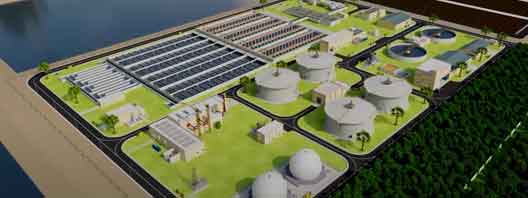
In the meantime, Dasherkandi STP with a capacity of 500 MLD has been constructed with the financial assistance of the Chinese Exim Bank.
In this backdrop, Dhaka WASA has planned and initiated Dhaka Sanitation Improvement Project according to its Sewerage Master Plan.